
Pull-out kitchen faucet hose planning is a small specification task with a large effect on multi-unit maintenance. Overseas importers, contractors, hotel teams, and apartment developers should evaluate the visible faucet together with the hose path, counterweight clearance, shutoff access, cartridge, aerator, and replacement-part plan.
Begin with the project sink cabinet, not a catalog image. Compare FaucetTaps pull-down and pull-out faucet options with the wider kitchen faucet range, then record cabinet dimensions and service constraints by room type.
Confirm the Hose Travel Zone
The hose must move freely without rubbing drawer runners, waste bins, filters, traps, or stored cleaning supplies. A counterweight needs a clear vertical path. Installers should test full extension and retraction after the drain and accessories are fitted, because an empty demonstration cabinet can hide future interference.
For island kitchens and compact apartments, confirm deck thickness, hole diameter, sink depth, spout reach, cabinet brace positions, and the distance between the hose and drain assembly. A documented clearance envelope makes installation repeatable across hundreds of rooms.
Match Spray Head, Hose, and Connections
The spray head, hose coupling, check valve, and faucet body form one service system. Buyers should request connection drawings and compatible part numbers rather than assuming that visually similar hoses are interchangeable. Confirm hose length, braid material, bend radius, pull force, docking method, and local pressure conditions.
Plan Cartridges, Aerators, and Shutoff Access
Cartridges and aerators are common service items. Record cartridge diameter, flow-control specification, aerator thread, and finish-sensitive trim components. Shutoff valves should remain reachable without removing the sink or damaging cabinetry. General efficiency targets can be checked against EPA WaterSense guidance, while local codes and project requirements remain controlling.
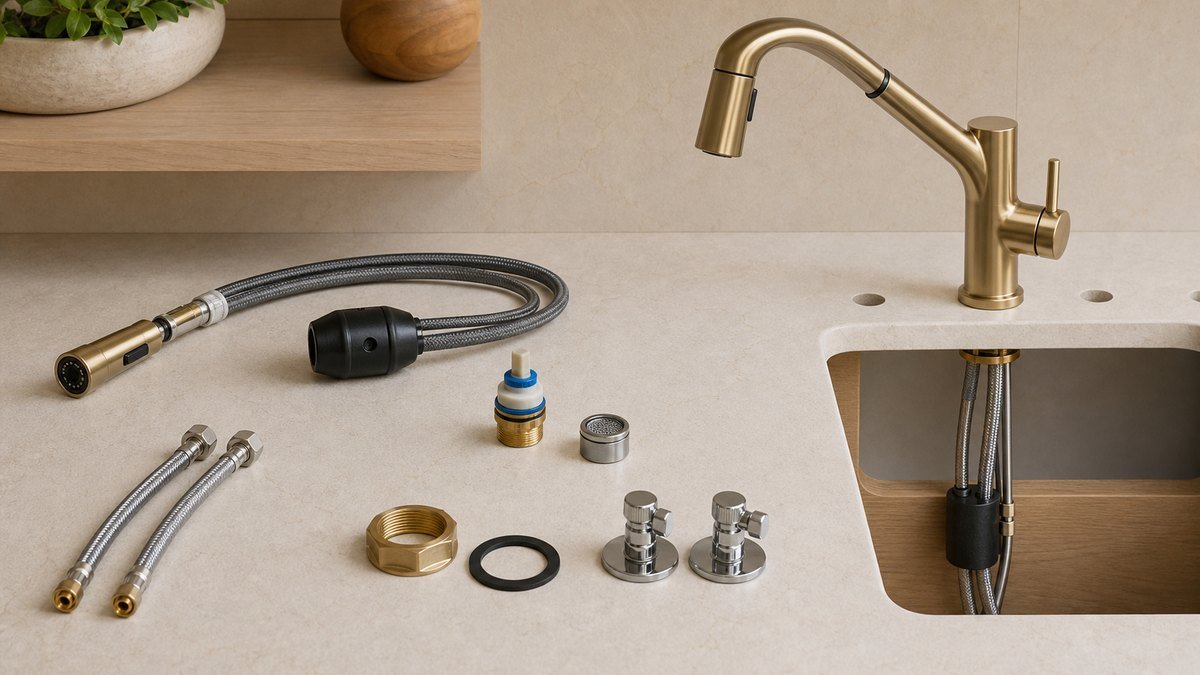
Build a Multi-Unit Spare-Parts Schedule
For apartments, hotels, and wholesale programs, keep a model-to-part matrix covering hoses, spray heads, cartridges, aerators, mounting kits, gaskets, and finish codes. Specify initial spare quantities, reorder MOQ, packaging labels, and expected lead time. This allows a maintenance team to identify the correct part without dismantling another room.
Questions for the Faucet Supplier
Ask for dimensional drawings, pressure test information, hose-cycle testing, material declarations, installation instructions, carton marking, finish samples, and after-sales compatibility lists. If the same development uses a main sink faucet and a smaller bar faucet, align finishes and common service parts where practical.
Turn Service Planning into a Procurement Advantage
A pull-out faucet should retract smoothly on day one and remain easy to repair years later. Include cabinet clearance, hose routing, counterweight position, spare parts, and maintenance access in the approval sample. For a project-specific review, contact the FaucetTaps team with sink drawings, quantities, target finishes, and destination-market requirements.