
Introduction
If you’re bidding on a LEED-certified hotel, a government building renovation, or a multi-family residential development in a drought-prone state, one word will appear in every plumbing specification: WaterSense.
WaterSense is the U.S. Environmental Protection Agency’s (EPA) voluntary water efficiency labeling program. Think of it as ENERGY STAR for water. A WaterSense-labeled bathroom faucet uses at least 30% less water than a standard model—1.5 gallons per minute (GPM) versus the federal maximum of 2.2 GPM—without any noticeable drop in performance.
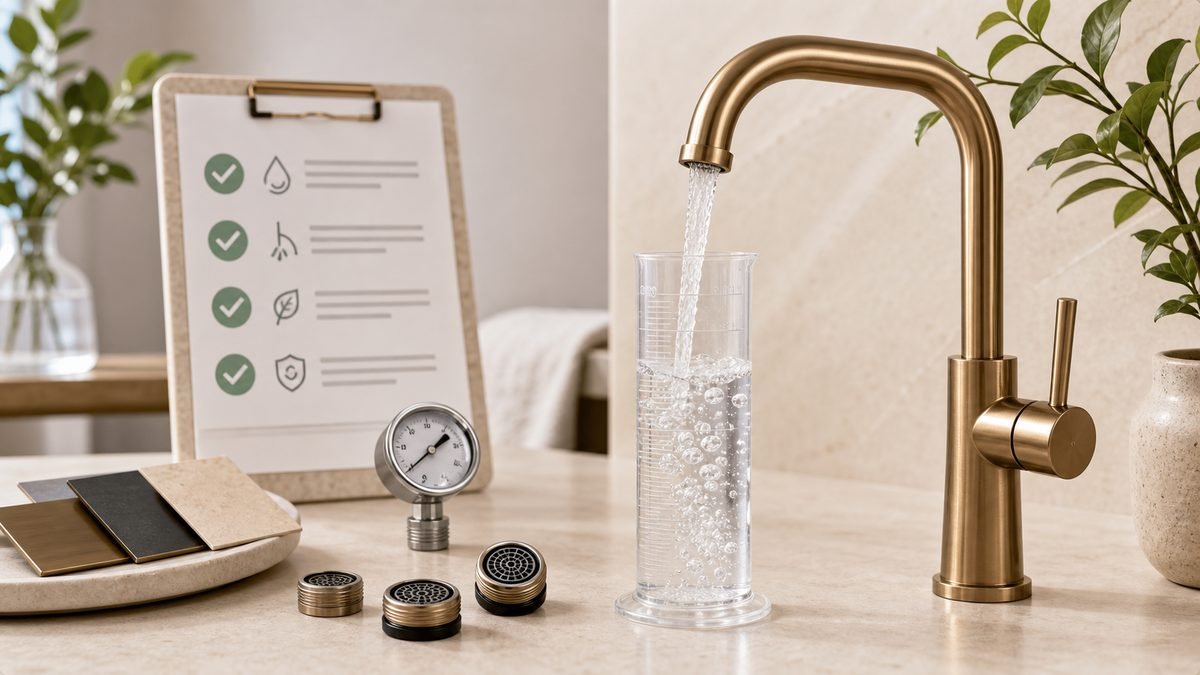
But here’s the thing most international buyers don’t realize: WaterSense is not just about flow rate. It’s a full certification program with independent third-party testing, lifecycle performance requirements, and strict lead-free material standards. And as of 2026, the program is in the middle of a major revision that will lower the maximum flow rate even further.
This guide covers what specifiers and buyers need to know: which faucets qualify, how certification works, what Version 2.0 changes, and how to source compliant faucets from a manufacturer.
1. Which Faucets Can Earn WaterSense?
The WaterSense label currently applies to only one faucet category:
| Faucet Type | WaterSense Eligible? | Maximum Flow Rate |
|---|---|---|
| Private lavatory (bathroom sink) faucets | ✅ Yes | 1.5 GPM (V1.0) |
| Private lavatory faucet accessories (aerators) | ✅ Yes | 1.5 GPM |
| Kitchen faucets | ❌ Not yet (paused) | 2.2 GPM (federal std) |
| Public lavatory faucets | ❌ Not yet (paused) | 0.5 GPM (code requirement) |
| Metering faucets | ❌ No | 0.25 GPC |
| Bar faucets | ❌ Being removed | N/A |
The “private lavatory” distinction matters. WaterSense defines this as faucets in bathrooms within homes, apartments, hotel guest rooms, hospital patient rooms, and senior care units. If your project includes public restrooms (airports, shopping malls, office buildings), those faucets fall under a different code requirement (0.5 GPM maximum) and are not WaterSense-eligible under current criteria.
2. WaterSense Certification Requirements
To earn the WaterSense label and be listed in the EPA’s product directory, a faucet must pass three independent certification checks:
2.1 Water Efficiency
| Requirement | Specification |
|---|---|
| Maximum flow rate (V1.0) | 1.5 GPM at 60 psi inlet pressure |
| Minimum flow rate | 0.8 GPM at 20 psi (ensures adequate flow in low-pressure homes) |
| Testing standard | ASME A112.18.1 / CSA B125.1 |
2.2 Lead-Free Compliance
WaterSense-labeled faucets must meet the lead-free requirements of Section 1417 of the Safe Drinking Water Act:
| Parameter | Limit |
|---|---|
| Weighted average lead content | ≤ 0.25% |
| Certification standard | NSF/ANSI 372 |
| Solder and flux | ≤ 0.2% lead |
This means all wetted surfaces—brass body, waterways, connections—must use lead-free materials. Traditional free-machining brass (C36000, 2.5–3.7% lead) is incompatible with WaterSense requirements.
2.3 Performance & Lifecycle
| Test | What It Verifies |
|---|---|
| Lifecycle testing | Faucet continues functioning through its expected service life under repeated use |
| Minimum flow at low pressure | Adequate flow for handwashing and shaving at 20 psi |
| Drip-free shutoff | No leaking after 500,000 on/off cycles |
2.4 Independent Third-Party Certification
Manufacturers cannot self-declare WaterSense compliance. All products must be tested and certified by an EPA-licensed certifying body. Current licensed certifiers include:
- IAPMO R&T
- ICC Evaluation Service
- NSF International
- CSA Group
3. Version 2.0: What’s Coming (Paused as of Feb 2025)
In December 2024, the EPA released a draft of WaterSense Specification Version 2.0. While the revision has been paused for review, the direction of travel is clear:
Key Proposed Changes
| Change | V1.0 (Current) | V2.0 (Proposed) |
|---|---|---|
| Maximum flow rate | 1.5 GPM | 1.2 GPM |
| Bar faucets | Included | Removed from scope |
| Private metering faucets | Not included | Included (with WaterSense accessory) |
| Cold-start designation | Not available | New optional criteria (cold-start faucets that reduce hot water use) |
| Kitchen faucets | Not eligible | Planned scope expansion (paused Feb 2025) |
| Public lavatory faucets | Not eligible | Planned scope expansion (paused Feb 2025) |
What This Means for Buyers
- If you’re specifying faucets today, V1.0 (1.5 GPM) is the current enforceable standard
- When V2.0 takes effect, faucets certified at 1.5 GPM may need recertification at 1.2 GPM
- The cold-start optional criteria could become a differentiator for energy-efficient building certifications
- Kitchen faucet WaterSense criteria are being developed—this will be a significant market shift when finalized
4. The Certification Process for Manufacturers
Step 1: EPA Partnership Agreement
Before submitting products for testing, manufacturers must sign a WaterSense partnership agreement with the EPA. This is free but requires:
- Corporate commitment to the WaterSense program goals
- Agreement to follow WaterSense labeling and marketing guidelines
- Commitment to report annual shipment data to the EPA
Step 2: Product Testing by Licensed Certifier
The manufacturer submits product samples to an EPA-licensed certifying body (e.g., IAPMO, NSF). Testing includes:
- Flow rate measurement at 20, 45, 60, and 80 psi
- Lifecycle endurance testing
- Lead content verification (NSF/ANSI 372)
- Material safety review
Step 3: Certification & Listing
Once the product passes, the certifier submits a Product Notification Template (PNT) to the EPA. The product is then listed in the WaterSense product directory and can display the WaterSense label.
5. How to Verify Manufacturer Compliance
Check the WaterSense Product Directory
Visit lookforwatersense.epa.gov and search by manufacturer name. A legitimate listing shows:
- Manufacturer legal name
- Product model number(s)
- Certifying body
- Certification date
Confirm Lead-Free Compliance
WaterSense-labeled faucets must also pass NSF/ANSI 61 and NSF/ANSI 372. Always request:
- The NSF 372 certificate for the specific model
- Alloy composition certificates showing lead ≤ 0.25%
- Third-party lab extraction test reports
Verify the Certifier Is EPA-Licensed
Only certification bodies licensed by the EPA can issue WaterSense certifications. Self-declared “meets WaterSense criteria” is not valid.
6. Common Misconceptions
“Any faucet under 1.5 GPM is WaterSense.”
False. The flow rate is just one of several requirements. A faucet must also pass lifecycle, lead-free, and third-party certification checks to earn the label.
“WaterSense is mandatory nationwide.”
False. WaterSense is a voluntary labeling program. However, many state and local building codes, green building certifications (LEED, NGBS), and utility rebate programs require or incentivize WaterSense-labeled products. In practice, for commercial and multi-family projects, WaterSense is effectively mandatory.
“Kitchen faucets can be WaterSense labeled.”
False—at least for now. The EPA does not currently have WaterSense criteria for kitchen faucets. Kitchen faucets are governed by the federal maximum flow rate of 2.2 GPM. The EPA has signaled intent to develop kitchen faucet criteria, but this was paused in February 2025.
“The WaterSense label doesn’t matter for commercial projects.”
WaterSense-labeled faucets are explicitly referenced in:
- LEED v4.1 Water Efficiency credits
- National Green Building Standard (NGBS) water efficiency practices
- CALGreen mandatory water efficiency requirements
- Various state and municipal rebate programs
7. WaterSense Rebates and Incentives
Many U.S. water utilities offer rebates for WaterSense-labeled bathroom faucets, typically ranging from $25 to $150 per faucet. These rebates can significantly offset the incremental cost of WaterSense-compliant models for project-scale purchases.
To find available rebates in your project’s service area, search by ZIP code at the WaterSense Rebate Finder.
8. What FaucetTaps Offers
FaucetTaps manufactures WaterSense-compliant bathroom faucets with:
- Flow rates tested and verified at 1.5 GPM at 60 psi (V1.0 compliant)
- Lead-free brass alloys (C69300 / C87850) for all wetted components
- NSF/ANSI 61 and NSF/ANSI 372 certification available per model
- PVD surface finishes with zero electroplating wastewater concerns
- OEM/ODM with your brand’s WaterSense application support
Contact us to request flow test reports, lead-free compliance documentation, or product samples for your own third-party verification.
Last updated: July 2026. Check the EPA WaterSense website for the latest specification updates.
For project sourcing support, explore Kitchen Faucets, Bathroom Faucets, or contact FaucetTaps for specification and quotation assistance.