
Introduction
If you’re sourcing faucets for the North American market—whether you’re a plumbing wholesaler, a hotel procurement manager, or a residential developer—there’s one certification that can make or break your project: NSF/ANSI 61.
It’s not optional. In 48 U.S. states, faucets and plumbing fixtures that come into contact with drinking water must meet NSF/ANSI 61 requirements before they can be legally sold or installed. Without this certification, your shipment gets stuck at customs, your contractor won’t sign off, and your insurance won’t cover the liability.
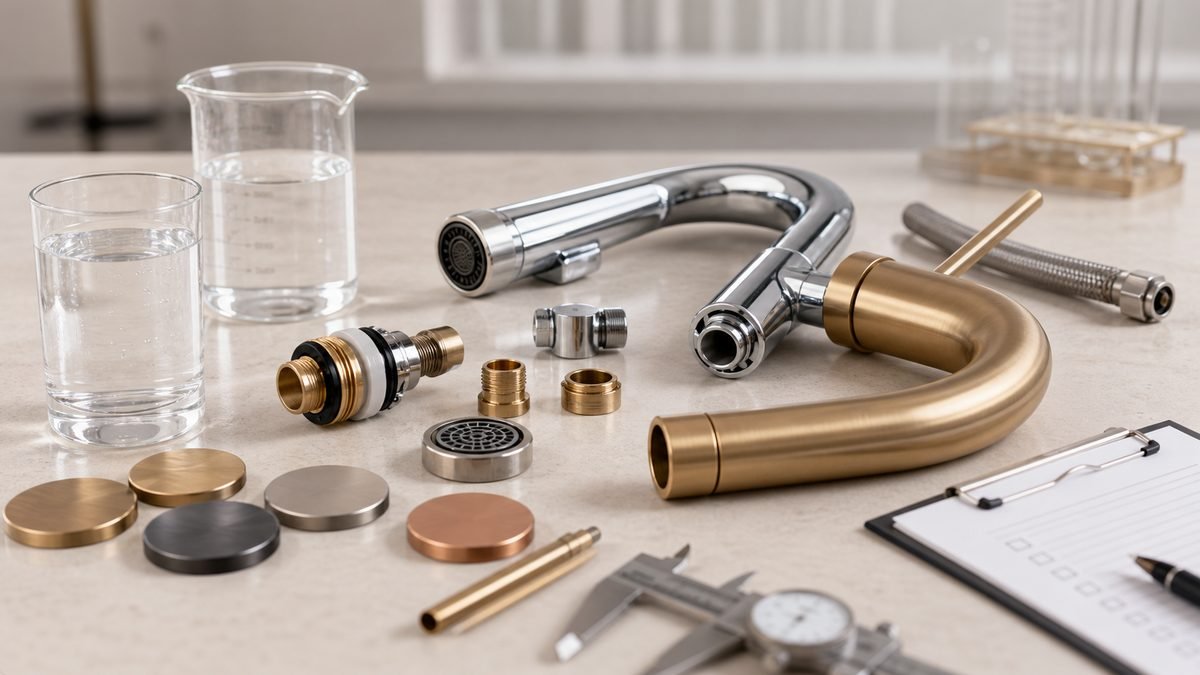
But here’s what most buyers get wrong: NSF/ANSI 61 is not static. The standard evolves, and the 2025 edition (NSF/ANSI/CAN 61-2025) introduced significant changes that directly affect faucet specifications. If you’re still referencing the 2019 or even 2023 version, you’re already behind.
This guide covers everything a project buyer needs to know: what the standard actually tests, how certification works, what changed in 2025, and how to verify your Chinese manufacturer’s compliance before the order leaves the factory.
1. What Is NSF/ANSI 61?
NSF/ANSI 61—full title Drinking Water System Components – Health Effects—is the North American standard that sets minimum health-effect requirements for any product, component, or material that contacts drinking water.
Key scope details:
| Covered | Not Covered |
|---|---|
| Chemical contaminants leaching into water | Taste, odor, or aesthetic factors |
| Pipes, valves, fittings, faucets, coatings | Microbial growth |
| Water treatment media (activated carbon, sand) | Product performance or durability |
| Gaskets, O-rings, sealants, solders | Installation requirements |
The standard is developed by NSF International, an ANSI-accredited standards developer, in collaboration with the American National Standards Institute (ANSI) and the Standards Council of Canada (SCC). The 2025 edition is formally designated NSF/ANSI/CAN 61-2025.
Legal status: While NSF 61 itself is a voluntary consensus standard, it is referenced into law by the U.S. Safe Drinking Water Act (SDWA) and adopted by plumbing codes in the majority of U.S. states. In practical terms, this means: no NSF 61 certification, no legal sale in the U.S. market.
2. Which Faucet Components Need Certification?
NSF 61 classifies products into several sections. Faucets fall primarily under Section 9: Mechanical Plumbing Devices (Endpoint Devices).
| Component | Relevant NSF 61 Section | What’s Tested |
|---|---|---|
| Faucet body (brass, stainless steel, zinc) | Section 9 | Metal leaching: lead, copper, zinc, chromium |
| Internal waterways, cartridges | Section 9 | Chemical extraction from plastics, rubber |
| Flexible supply hoses, connectors | Section 9 | Q-value ≤ 0.5 μg for lead |
| Spray heads, aerators | Section 9 | Full endpoint device requirements |
| Coatings and finishes (PVD, electroplating) | Section 4 | Leaching from protective materials |
| Gaskets, O-rings, seals | Section 3 | Extractables from elastomers |
Critical distinction: Every component that contacts drinking water must be individually certified OR the complete assembled faucet must pass endpoint testing. If your manufacturer changes a gasket supplier mid-production, the certification can be voided.
3. 2025 Standard Updates That Matter for Faucets
The 2025 edition is not a minor revision. Several changes directly impact faucet specification and procurement:
3.1 Lead Release Q-Value Tightened
The maximum lead release Q-value for endpoint devices (Section 9) was reduced:
| Version | Lead Q-Value (Endpoint Devices) |
|---|---|
| Pre-2023 | 5.0 μg |
| 2023 | 1.0 μg |
| 2025 | 1.0 μg (maintained, now fully enforced) |
For flexible supply connectors and check valves, the limit is even stricter: 0.5 μg.
3.2 Lead Content Limit (NSF/ANSI 372)
The SDWA Section 1417 amendment (effective January 4, 2014) mandates that the weighted average lead content across all wetted surfaces must not exceed 0.25%. The 2025 standard continues to reference NSF/ANSI 372-2024 for lead content verification, moving the former Annex G content into its own dedicated standard.
What this means for brass faucets: Traditional free-machining brass (C36000) contains 2.5–3.7% lead. It cannot pass NSF/ANSI 372 lead content requirements. Faucet manufacturers must use lead-free brass alloys (C69300, C87850), stainless steel, or engineered polymers for wetted components.
3.3 New PFAS Testing for Fluoropolymer Materials
The 2024 edition (incorporated into 2025) expanded testing requirements for per- and polyfluoroalkyl substances (PFAS) in fluoropolymer materials. If your faucet uses PTFE seals, Teflon tape, or fluoropolymer-lined hoses, these components now require additional chemical extraction testing.
3.4 Hot Water Application Temperature Options
Section 3.1.6.3 now provides explicit temperature options for hot water applications. This is particularly relevant for kitchen faucets, which are expected to deliver water up to 140°F (60°C) in commercial settings.
3.5 Asbestos Prohibition
Section 3.7 (added in 2024, carried into 2025) explicitly prohibits the use of asbestos-containing products in any certified component. While rare in modern faucet manufacturing, this formalizes what was previously an implicit expectation.
4. The Certification Process: Step by Step
Getting a faucet NSF/ANSI 61 certified is not a one-week process. Here’s the typical timeline:
Step 1: Application & Material Disclosure (2–4 weeks)
The manufacturer submits an application to NSF International (or an ANSI-accredited third-party certifier) with a complete Bill of Materials (BOM) for every wetted component. This includes:
- Alloy composition certificates for the faucet body
- Material safety data sheets (MSDS) for gaskets, O-rings, lubricants
- Coating formulation details (PVD target material, electroplating bath chemistry)
- Supply chain documentation for purchased components (cartridges, hoses, aerators)
Step 2: Product Testing (6–12 weeks)
The certifier selects sample products from the production line and conducts extraction testing under standardized conditions:
| Test Parameter | Value |
|---|---|
| Exposure water | pH 5.0 and pH 10.0 (aggressive and non-aggressive) |
| Temperature | 23°C ± 2°C (cold), with optional hot water testing |
| Exposure duration | 24-hour stagnation periods, repeated over 19 days |
| Surface-area-to-volume ratio | Calculated per product geometry |
| Analytes tested | Lead, copper, zinc, chromium, cadmium, antimony, plus organic extractables |
The laboratory measures the concentration of each analyte in the exposure water and compares it to the Single Product Allowable Concentration (SPAC) and Total Allowable Concentration (TAC) limits defined in the standard.
Step 3: Factory Audit (1–2 weeks on-site)
NSF sends an auditor to the manufacturing facility to verify:
- Quality management system (ISO 9001 or equivalent)
- Incoming material inspection records
- Production traceability (can the manufacturer trace every component lot to its material certificate?)
- Change management process (how are material substitutions approved?)
Step 4: Certification Decision & Listing (2–4 weeks)
If the product passes testing and the factory passes the audit, the certification is issued. The product is listed in NSF’s online certification directory, and the manufacturer can apply the NSF 61 mark to the product.
Annual surveillance: Certification is not permanent. NSF conducts unannounced annual factory audits and periodic re-testing. If a manufacturer changes a component supplier without NSF approval, the certification is suspended.
5. How to Verify Your Manufacturer’s NSF 61 Compliance
Before placing a purchase order, confirm these four things:
5.1 Check the NSF Online Listing
Visit info.nsf.org/Certified/Lead_Content and search for the manufacturer’s name and product model. A legitimate listing shows:
- Manufacturer legal name (must match the entity on your contract)
- Certified product model numbers
- Certification scope (Section 9, endpoint devices)
- Certification date and expiration
Red flag: If the manufacturer claims NSF 61 certification but their name doesn’t appear in the NSF database, ask for a copy of their certification letter directly from NSF—not a screenshot, not a PDF, but a verifiable reference.
5.2 Request Material Test Reports
For every production batch, request:
- Alloy composition certificate: From the brass/stainless steel mill, showing lead content ≤ 0.25%
- Third-party lab extraction test: From an ISO 17025-accredited laboratory
- Component traceability: Cartridge, hose, and gasket supplier certificates
5.3 Understand “Certified to NSF 61” vs “Tested to NSF 61 Standards”
There is a critical difference:
| Claim | Meaning | Reliable? |
|---|---|---|
| “NSF 61 Certified” | Product is listed in NSF’s certification directory, with ongoing surveillance | ✅ |
| “Tested to NSF 61 standards” | A lab test was conducted once, but no ongoing certification | ⚠️ Check who did the test |
| “Meets NSF 61 requirements” | Self-declared; no independent verification | ❌ |
Only “NSF 61 Certified” carries legal standing for code compliance.
5.4 Check for Complementary Certifications
A comprehensive faucet certification package should include:
| Certification | What It Covers |
|---|---|
| NSF/ANSI 61 | Chemical health effects |
| NSF/ANSI 372 | Lead content (≤ 0.25%) |
| ASME A112.18.1 / CSA B125.1 | Mechanical performance |
| EPA WaterSense | Water efficiency (1.5 GPM max for lavatory faucets) |
| California AB 1953 / VT S152 | State-specific lead-free requirements |
6. Common Misconceptions
“My faucet is stainless steel, so it doesn’t need NSF 61.”
False. Even 316 stainless steel contains alloying elements (chromium, nickel, molybdenum) that can leach into water under certain conditions. Every material that contacts drinking water must be tested.
“We already have NSF 61 certification from five years ago. Is it still valid?”
Not necessarily. Certification requires annual surveillance audits and periodic re-testing. If the manufacturer hasn’t maintained the certification, it may have lapsed. Additionally, if the 2025 standard changes (e.g., the PFAS testing requirement) were not addressed in the most recent audit, the certification may no longer cover the full current standard.
“PVD coating eliminates the need for lead-free brass.”
False. PVD is a surface treatment. It does not change the composition of the underlying brass. If the brass body contains lead, it will leach through any microscopic pinhole or wear point in the coating. The body material must meet NSF 372 lead content requirements regardless of the surface finish.
“NSF 61 certification is too expensive for small orders.”
The certification cost (typically $8,000–$25,000 for initial certification of a faucet product line) is a one-time investment that covers all subsequent production. When amortized over a production run of 10,000 units, the per-unit cost is $0.80–$2.50. For the North American market, this is not an optional cost—it’s the price of market access.
“Chinese manufacturers can’t get real NSF 61 certification.”
False. As of 2026, over 200 Chinese plumbing manufacturers hold active NSF 61 certifications. The key is verification: request the NSF listing number and verify it on the NSF website before signing the contract, not after the shipment arrives.
7. FAQ
Q: How long does NSF/ANSI 61 certification take from start to finish? A: Typically 4–6 months for a new product line. Rush programs can reduce this to 3–4 months at additional cost.
Q: Does NSF 61 cover both kitchen and bathroom faucets? A: Yes. All faucets that deliver water for drinking, cooking, or personal hygiene fall under Section 9 (endpoint devices).
Q: What’s the difference between NSF 61 and NSF 372? A: NSF 61 tests for chemical extraction (what comes OUT of the product into the water). NSF 372 tests for lead content (what’s IN the product material). Both are required for U.S. market compliance.
Q: Is NSF 61 required for commercial projects? A: Yes. Most U.S. state plumbing codes and the International Plumbing Code (IPC) reference NSF 61 as a mandatory requirement for all drinking water system components, regardless of whether the installation is residential or commercial.
Q: Can a faucet be sold in the U.S. without NSF 61? A: Only in the two states that have not adopted the model plumbing code referencing NSF 61. However, most wholesalers, retailers, and contractors will not accept uncertified products regardless of local code exceptions, because of liability concerns.
8. What FaucetTaps Offers
At FaucetTaps, we manufacture kitchen and bathroom faucets in Heshan, Guangdong—China’s faucet manufacturing capital—with full NSF/ANSI 61 and NSF/ANSI 372 compliance documentation available for every product line.
Our compliance package includes:
- NSF-certified lead-free brass (C69300 / C87850) for all wetted components
- Third-party ISO 17025 laboratory extraction test reports for every model
- Full material traceability from brass mill to finished faucet
- PVD surface finishes applied at 600°C in vacuum—free of electroplating wastewater concerns
- OEM/ODM capability: we can certify your custom design under your brand
Contact us to request certification documentation, sample products for your own lab testing, or a factory audit visit. We welcome on-site inspections by your quality assurance team or third-party inspection agencies.
9. Action Plan for Project Buyers
If you’re sourcing faucets for the North American market, here’s your checklist:
- [ ] Step 1: Confirm the manufacturer’s NSF 61 certification is current by searching NSF’s online directory
- [ ] Step 2: Request material test reports for your specific product models—not a different model that happens to be certified
- [ ] Step 3: Verify that the certification covers the 2025 standard (not an older version)
- [ ] Step 4: Require alloy composition certificates showing lead content ≤ 0.25% for every production batch
- [ ] Step 5: Include NSF 61 compliance as a contract requirement with specific penalties for non-compliance
- [ ] Step 6: Arrange third-party pre-shipment inspection with random sample extraction testing
- [ ] Step 7: File the certification documents with your project’s plumbing permit application
This guide was last updated in July 2026. For the most current version of NSF/ANSI 61-2025, refer to the NSF International standards portal.
For project sourcing support, explore Kitchen Faucets, Bathroom Faucets, or contact FaucetTaps for specification and quotation assistance.